The Dual Soul of Geography: Social Science vs. Spatial Science
Geography is often described as the “mother of all sciences,” a discipline that uniquely sits at the intersection of the natural and social worlds. But within this broad field, there exists a dynamic tension—and a powerful synergy—between two dominant paradigms: Geography as a Social Science and Geography as a Spatial Science.
🧠 The Social Science Perspective: Understanding “Place”
In the realm of social science, geography is deeply human. It is concerned with the “Why” and “How” of human existence in specific locations.
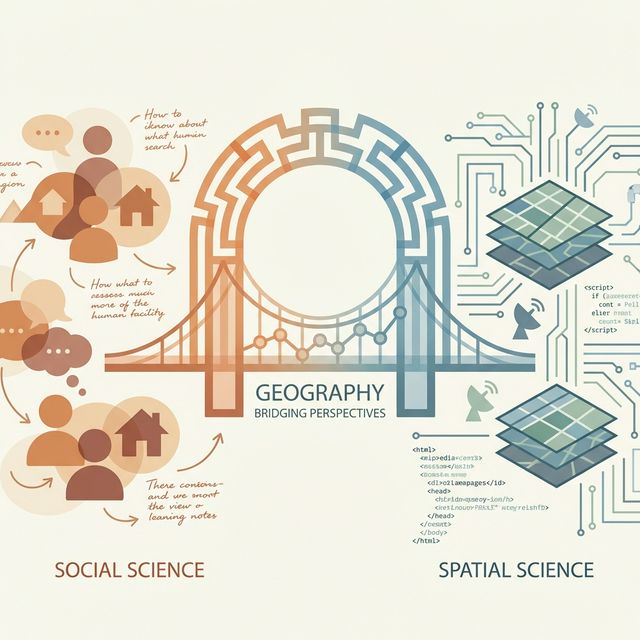
- Focus: Lived experience, culture, politics, and social structures.
- Key Concept: “Place” — a location imbued with meaning, memory, and social relationships.
- Methods: Qualitative approaches such as ethnography, interviews, participatory observation, and critical theory.
“Geography is not just about where things are, but about what they mean to the people who are there.”
Social geographers ask questions like: How does gentrification affect community identity? or What are the lived experiences of migration?
🛰️ The Spatial Science Perspective: Analyzing “Space”
On the other side of the spectrum lies spatial science, often driven by the “Quantitative Revolution” of the mid-20th century. Here, geography becomes a rigorous, measurable science.
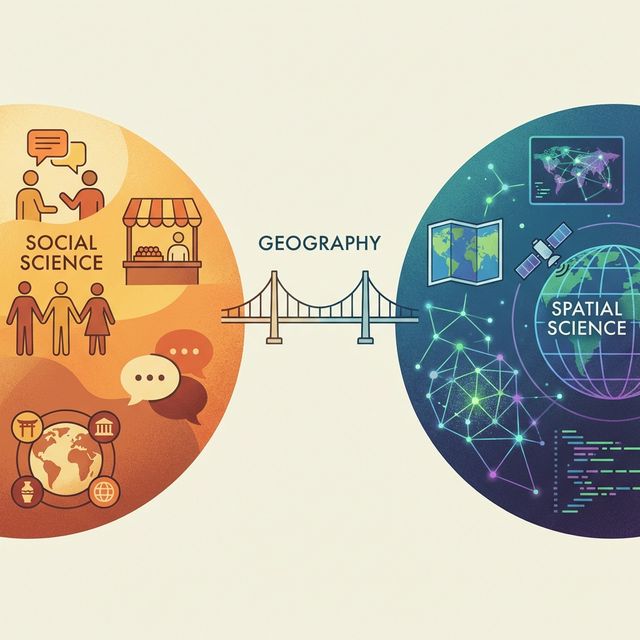
- Focus: Patterns, distributions, flows, and measurable phenomena.
- Key Concept: “Space” — an abstract, geometric surface where variables interact.
- Methods: Geographic Information Systems (GIS), Remote Sensing, spatial statistics, and geocomputation.
“Everything is related to everything else, but near things are more related than distant things.” — Waldo Tobler (First Law of Geography)
Spatial scientists ask: What is the optimal location for a new hospital? or How can we model the spread of a wildfire using satellite data?
🤝 The Convergence: Why We Need Both
For a long time, these two camps were seen as opposing forces—the “quants” vs. the “quals.” However, modern geography increasingly recognizes that this binary is false.
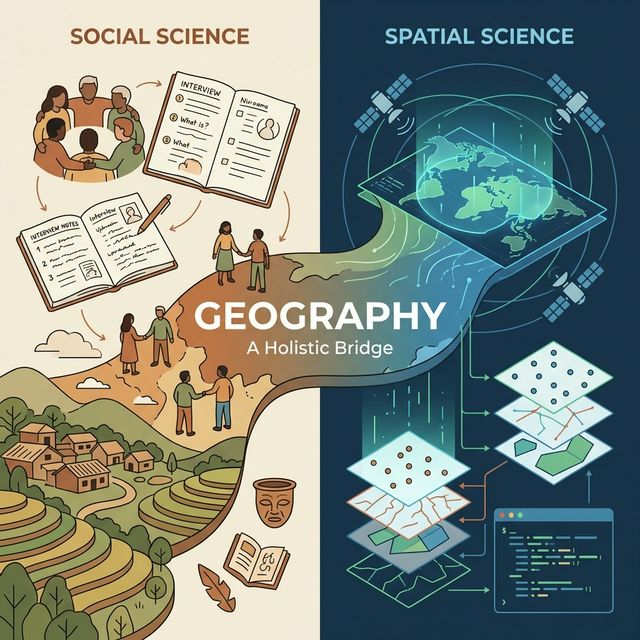
- GIS needs Context: A map of poverty rates (Spatial Science) is just data points without understanding the historical and political causes of that poverty (Social Science).
- Social Theory needs Grounding: abstract theories about inequality are more powerful when backed by rigorous spatial evidence.
The Rise of “Critical GIS” and “Geo-Humanities”
Today, we see a blending of these worlds. Critical GIS scholars use spatial tools to challenge social injustices, while Geo-Humanities researchers use maps to tell rich, human stories.
Conclusion
Whether you identify more as a social theorist or a spatial analyst, the strength of geography lies in its ability to synthesize. By combining the empathy of social science with the precision of spatial science, we gain a holistic understanding of our complex world.
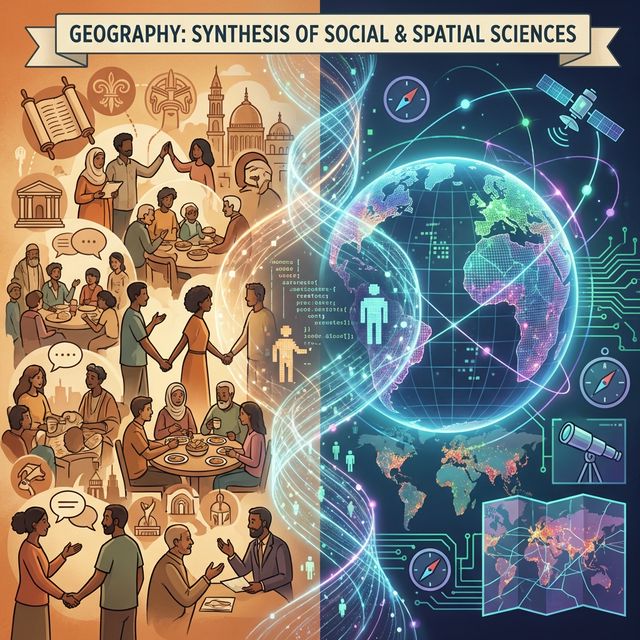
Geography isn’t just one or the other—it is the bridge between them.